
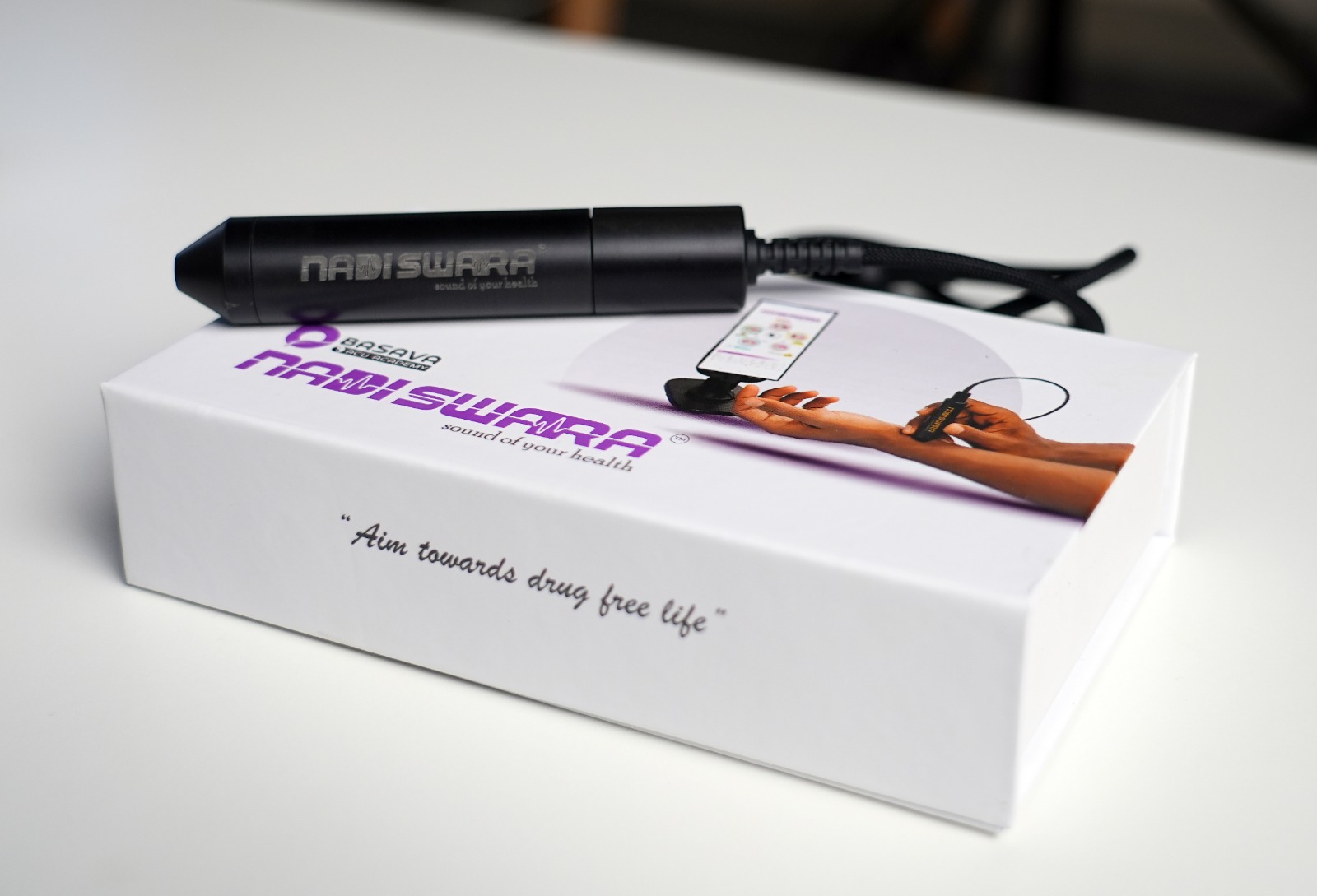
Every Nadi Pariksha Wellness Report depends on a small black probe resting on a wrist. The Nadiswara pulse sensor is the only piece of Nadiswara hardware in a session, and it has one job: capture the pulse at a single point and hand the signal to the app.
This article explains what that sensor is, where it sits, how the signal travels to the phone, what the short reading looks like on screen, and, just as important, what the probe does not do.
One point on the wrist
A practitioner performing Nadi Pariksha reads the pulse at several positions and pressures. The Nadiswara brochure describes the traditional method as sensing "the vibratory frequency of the pulse at various levels on the Radial artery", and adds that the practitioner "should sense the pulse at multiple positions by varying the pressure which requires more skills and time".
Nadiswara records one position only. The brochure calls this "single position wrist pulse analysis which avoids ambiguity for the practitioners over multiple positions". The probe rests on the wrist at one position for the reading: the wrist pulse the brochure describes for the traditional method, read at a single position instead of several. The brochure said a comparative study "can be done easily", which in the earlier report meant before-and-after charts. In today's app the comparison is the visit history: the Play Store listing says each member's history shows symptoms, meridian imbalance and TEM points, and a returning member's last session is shown before a new one begins.
What is Nadi Pariksha? explains the three-finger method that Nadiswara replaces with one position.
A microphone that listens for the pulse
The sensor inside the probe is a microphone. Nadiswara's research page states that the hardware "includes a microphone as the sensor to acquire the pulse", and the brochure lists "advanced filters to capture Nadi by eliminating background noise" among the device's features. In plain terms, the probe picks up the pulse wave at the wrist as a microphone would, and its filters remove background noise.
Nothing goes into the body. The app's FAQ describes the device as non-invasive and painless, reading "pulse vibrations without using any radiation, chemicals, or invasive tools".
From the probe to the phone
The analysis does not happen in the probe. The research page describes "an embedded module that connects by USB-C to an Android phone running the Nadiswara app". The app is compatible with Android only, and the sensor connects to the phone by USB-C.
An unregistered probe is flagged "Not registered" in the session, with an "Enroll this device" button. There is also a Device enrolment screen in the profile menu: it says "Plug in your Nadiswara device", reads the device's ID over the USB-C link and registers it to your account. From then on the app recognises the probe at the start of every session: the pulse screen shows "Connecting", then "Connected", and the "Start reading" button stays off until the sensor is ready.
The Play Store listing is clear about what the sensor is for: "Pulse reading is not possible without this device." It is equally clear that no device is needed for the Tongue Wellness Report, member management or past reports. Beyond the probe you need an Android phone with an internet connection and a prepaid wallet balance; sessions are paid from the wallet, there is no subscription, and you see the price before you pay. The app's terms add that the product warranty period for the Sensor Probe is six months from the date of registration.
The reading: a few calm seconds
With the probe settled on the wrist, the screen reads "sit still, breathe normally". The practitioner presses "Start reading", a short countdown ("seconds until the reading starts") gives the member time to settle, and then the reading runs for under a minute while the ring counts down "seconds left · reading your pulse".
During those seconds a live trace scrolls across the phone, with time in seconds along the bottom and amplitude up the side. Each beat appears as a wave in the trace. When the time is up the screen says "Reading captured", and the practitioner can swipe back through the trace before choosing "Analyse pulse" or "Retake". If nothing came through it says "No pulse signal captured" and offers only "Retake reading"; if the probe is unplugged it says "Device disconnected. Plug it in to continue." The app then shows "Analysing your pulse..." with the note "This takes a few seconds. Stay relaxed."
From signal to pulse trace
Once "Analyse pulse" is pressed, the app sends the recording to Nadiswara's cloud pipeline. The research page describes software that recognises "unknown pulse patterns by comparing them with known database pulse signals", and models that keep learning when practitioners confirm or reject the findings.
The recording then appears on the report's Overview tab as "Pulse recording": the trace, captioned with the number of samples and "Nadiswara device", with a paragraph naming the pulse qualities traditional medicine uses and, below it, a "Five Elements" card, "How the five elements show in your pulse". One sample reading named Choppy, Slippery and Full Rapid; another described a Deep and Slow pulse. The findings those qualities point to appear further down as "Your main patterns". Inside the Nadiswara wellness report walks through the rest of the report.
So the chain is short: one point on the wrist, a microphone and its filters, a USB-C connection, a few seconds of stillness, and a trace that a practitioner can read beside their own fingers.
What the sensor is not
It is worth being plain about the limits, because a probe on a wrist invites comparison with instruments that do something different.
- Not a diagnostic medical device. The app's FAQ says so in those words. The app's report screen adds that the content is "shared for educational and wellness awareness purposes only. It is not medical advice or treatment."
- Not a medical instrument. The trace is read for its qualities, such as depth, speed, smoothness and force, in the language of traditional medicine, not as a replacement for the measurements a doctor would take.
- Not a replacement for a doctor. The app says this too. Everything a report suggests is what a practitioner may consider, and any health condition belongs with a qualified doctor.
- Not a stand-alone device. The probe captures and filters the signal, but the report comes from the Nadiswara app on an Android phone and its cloud pipeline. It is one of two ways into a wellness report: the other is the Tongue Wellness Report, which needs no hardware at all.